German design bureaus during World
War II were known for some of the most ahead-of-their time concepts ever
developed. While many of these dealt with long-range artillery or feats of
aviation, at least one concept ground vehicle has achieved considerable fame
among military history enthusiasts. The most famous of these was the German
attempt at a “Super-heavy” tank. This vehicle, codenamed the Maus, was designed
by none other than Ferdinand Porsche and his company (yes, the same luxury car
maker), and was approved as a way to keep Porsche and his machinations out of
other projects where it was more important those projects did not fail.
Ferdinand’s Maus (and other tanks he had designed that were found in design
documents after the fall of Berlin) were conceived as extremely large and
imposing war machines, taking the concept of the heavy tank and cranking it up
to eleven.

The Maus Superheavy V2 during it's testing
The Maus being the only one ever built before the end of the war
(much to Hitler’s surprise, actually, given the results of Porsche’s armor
projects in the past), it was – and still is – the heaviest armored combat vehicle
ever created, weighting in at nearly 188 tons; It was well-armored, with an
average of ten inches of armor on the tank, at times increasing to eighteen
inches; It was big, big enough to dwarf even the massive Tiger and Panther,
standing 3.6 meters tall, and similarly wide, the vehicle dwarfed most American
and Soviet tanks of the time; It was well-armed, fitted with a 128mm KwK 44 cannon
in the main turret, with a further 75mm KwK 44 cannon in the coaxial position,
eschewing the traditional coaxial machine gun (as the tank was envisioned to be
impervious to infantry, why worry about them?); And it was slow, with a top
speed of just over eight miles-per-hour. The Maus was designed to strike fear
into the heart of the enemy, and then destroy any enemy tank it encountered,
all while being able to withstand assault from an entire squad of tanks. For
the purposes of breaking enemy lines, five Maus tanks were ordered, however
only two hulls and one turret were ever completed. The Maus never saw actual
combat until the final months of the war, where the turretless V1 and the
turret-equipped V2 prototype were ordered to Wünsdorf to assist in the
defense there. The V2 en route encountered a Soviet force, which destroyed it
by sending infantry to place explosive charges in the engine compartments,
which were exposed. The hull was completely devastated when the ammunition
detonated, but the turret was left completely intact.

The Maus V2 after it's run-in with Soviet forces. Note that while the hull is completely destroyed, the turret and gun are more or less intact
The Maus V1 was captured
en route, having no means to defend itself. Having captured a working turret
and a working hull, the Soviets combined the remaining parts of the Maus V1 and
V2, and then did nothing with it. The vehicle now resides in the Kubinka Tank
Museum in Russia, where it currently awaits a restoration project to restore it
to working order. All other Maus prototypes were destroyed.
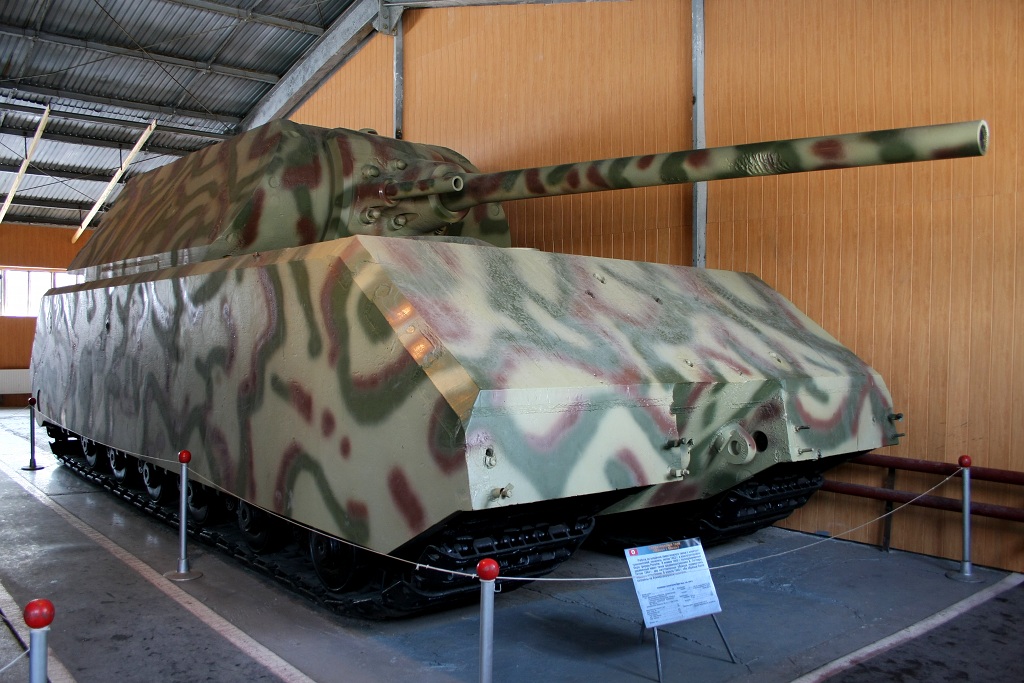
The Maus at the Kubinka Tank Museum, where it awaits a project to restore the tank to working order

No comments:
Post a Comment