When people think about heavy tanks, one of the first things
to comes to mind is big guns and big explosions, both of which are part of the
Heavy tank’s purvey. Having enough armor to lead a charge across an open field
and make it through relatively unscathed is worthless if when you get to the
enemy line you can’t do anything to it. As a fix for this, heavy tanks carry incredibly
large cannons well-suited to breaking lines, vehicles, or buildings. Here is
where some of the main design philosophies differed the most. The Germans focused
on building mostly very long, very high-velocity long-range cannons With superb
penetrating ability. This was part of what made the Tiger’s reputation, as its
88 millimeter Kwk-36 cannon could penetrate through tank armor with ease at ranges
where it would be very hard to retaliate against them. This also meant that
more ammunition could be carried, and it was easier and faster to reload the
main cannon for another shot.

A Tiger I tank in a field. Note the size of the cannon compared to the rest of the tank
On the other hand, was Soviet
cannon design philosophy, which could care less about the length of the bun so
long as the tank drivers were hitting and destroying targets. However, this
meant that many Soviet cannons lacked the stopping power of German cannons of
similar size. In response, the Soviets simply developed bigger instead of
better guns. Soviet builders recognized that at some point an incoming round
was going to be so big that no matter how good your armor was, a round fired
was going to penetrate or at least severely damage an enemy even despite armor.
It was not uncommon for the Soviets to simply fit their Heavy Tanks with
cannons from anti-tank artillery and roll those into battle. The most famous
example of this was the Soviet KV-2, which incorporated the largest tank cannon
in WWII, a 152mm beast of a cannon that could fell most German tanks at the
time with a single shot. However, this cannon was also a lesson in the fact
that there is such a thing as “too big” – the KV-2 was prone to knocking itself
over if it fired its gun perpendicular ot the direction of the tank body.
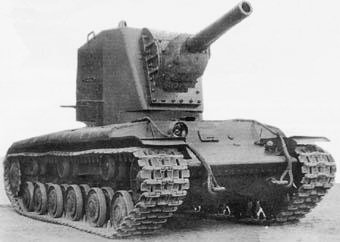
A KV - 2. Again, note the size of the cannon compared to the rest of the tank

No comments:
Post a Comment