Thursday, December 11, 2014

Image and Information Sources

Images and Information sourced from:

"World War II Vehicles, Tanks, Airplanes, and Guns." World War II Vehicles, Tanks, Airplanes, Guns, and Ships. N.p., n.d. Web. 11 Dec. 2014.

Zaloga, Steve, Jim Kinnear, and Peter Sarson. KV-1 & 2 Heavy Tanks 1939-45. Oxford: Osprey Pub., 1995. Print.

"Under the Tiger's Skin." Popular Science June 1945: 68-69. Print.

"Panzerkampfwagen VI Tiger (P) VK4501(P) / Porsche Typ 101." Achtung Panzer RSS. Achtung Panzer, n.d. Web. 11 Dec. 2014.

The Maus and the concept of the Superheavy Tank

German design bureaus during World War II were known for some of the most ahead-of-their time concepts ever developed. While many of these dealt with long-range artillery or feats of aviation, at least one concept ground vehicle has achieved considerable fame among military history enthusiasts. The most famous of these was the German attempt at a “Super-heavy” tank. This vehicle, codenamed the Maus, was designed by none other than Ferdinand Porsche and his company (yes, the same luxury car maker), and was approved as a way to keep Porsche and his machinations out of other projects where it was more important those projects did not fail. Ferdinand’s Maus (and other tanks he had designed that were found in design documents after the fall of Berlin) were conceived as extremely large and imposing war machines, taking the concept of the heavy tank and cranking it up to eleven.
The Maus Superheavy V2 during it's testing


 The Maus being the only one ever built before the end of the war (much to Hitler’s surprise, actually, given the results of Porsche’s armor projects in the past), it was – and still is – the heaviest armored combat vehicle ever created, weighting in at nearly 188 tons; It was well-armored, with an average of ten inches of armor on the tank, at times increasing to eighteen inches; It was big, big enough to dwarf even the massive Tiger and Panther, standing 3.6 meters tall, and similarly wide, the vehicle dwarfed most American and Soviet tanks of the time; It was well-armed, fitted with a 128mm KwK 44 cannon in the main turret, with a further 75mm KwK 44 cannon in the coaxial position, eschewing the traditional coaxial machine gun (as the tank was envisioned to be impervious to infantry, why worry about them?); And it was slow, with a top speed of just over eight miles-per-hour. The Maus was designed to strike fear into the heart of the enemy, and then destroy any enemy tank it encountered, all while being able to withstand assault from an entire squad of tanks. For the purposes of breaking enemy lines, five Maus tanks were ordered, however only two hulls and one turret were ever completed. The Maus never saw actual combat until the final months of the war, where the turretless V1 and the turret-equipped V2 prototype were ordered to Wünsdorf to assist in the defense there. The V2 en route encountered a Soviet force, which destroyed it by sending infantry to place explosive charges in the engine compartments, which were exposed. The hull was completely devastated when the ammunition detonated, but the turret was left completely intact.

The Maus V2 after it's run-in with Soviet forces. Note that while the hull is completely destroyed, the turret and gun are more or less intact


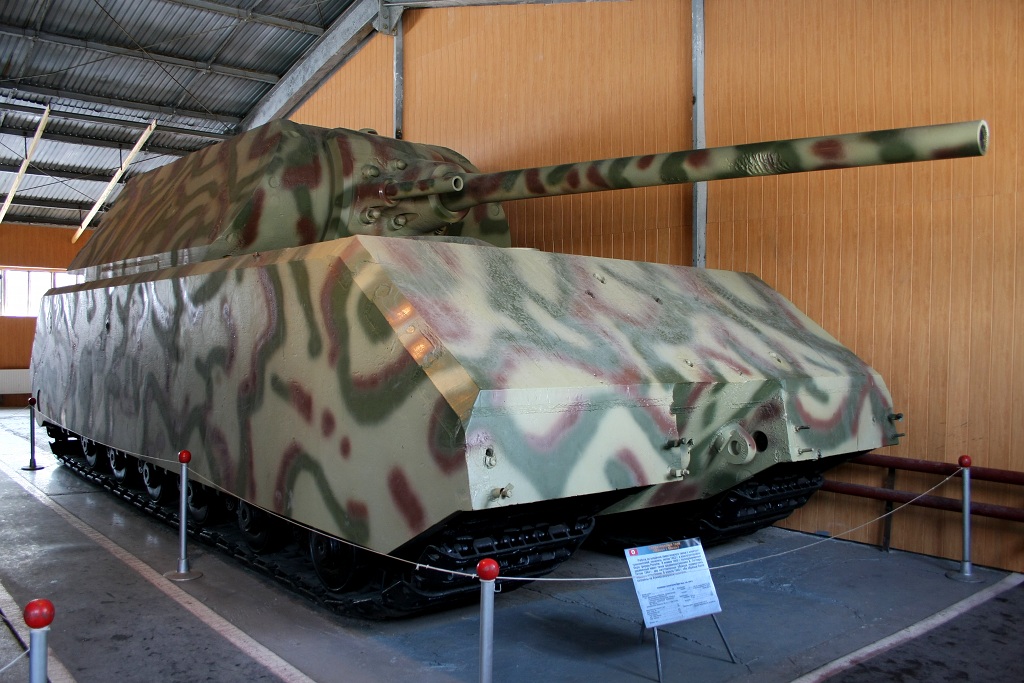
 The Maus V1 was captured en route, having no means to defend itself. Having captured a working turret and a working hull, the Soviets combined the remaining parts of the Maus V1 and V2, and then did nothing with it. The vehicle now resides in the Kubinka Tank Museum in Russia, where it currently awaits a restoration project to restore it to working order. All other Maus prototypes were destroyed.

The Maus at the Kubinka Tank Museum, where it awaits a project to restore the tank to working order

Monday, December 8, 2014

Big Guns

When people think about heavy tanks, one of the first things to comes to mind is big guns and big explosions, both of which are part of the Heavy tank’s purvey. Having enough armor to lead a charge across an open field and make it through relatively unscathed is worthless if when you get to the enemy line you can’t do anything to it. As a fix for this, heavy tanks carry incredibly large cannons well-suited to breaking lines, vehicles, or buildings. Here is where some of the main design philosophies differed the most. The Germans focused on building mostly very long, very high-velocity long-range cannons With superb penetrating ability. This was part of what made the Tiger’s reputation, as its 88 millimeter Kwk-36 cannon could penetrate through tank armor with ease at ranges where it would be very hard to retaliate against them. This also meant that more ammunition could be carried, and it was easier and faster to reload the main cannon for another shot.

A Tiger I  tank in a field. Note the size of the cannon compared to the rest of the tank


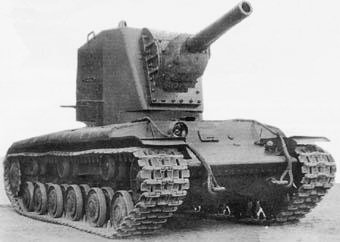
On the other hand, was Soviet cannon design philosophy, which could care less about the length of the bun so long as the tank drivers were hitting and destroying targets. However, this meant that many Soviet cannons lacked the stopping power of German cannons of similar size. In response, the Soviets simply developed bigger instead of better guns. Soviet builders recognized that at some point an incoming round was going to be so big that no matter how good your armor was, a round fired was going to penetrate or at least severely damage an enemy even despite armor. It was not uncommon for the Soviets to simply fit their Heavy Tanks with cannons from anti-tank artillery and roll those into battle. The most famous example of this was the Soviet KV-2, which incorporated the largest tank cannon in WWII, a 152mm beast of a cannon that could fell most German tanks at the time with a single shot. However, this cannon was also a lesson in the fact that there is such a thing as “too big” – the KV-2 was prone to knocking itself over if it fired its gun perpendicular ot the direction of the tank body.

A KV - 2. Again, note the size of the cannon compared to the rest of the tank

Armor and Heavy Tanks

The most important part of any tank is the armored shell that protects components and crew alike. For Heavy Tanks, this protection is even more important due to the nature of operations heavy tanks are used on, which will often leave them exposed to counterfire from enemy tanks and antitank weapons for extended periods of time. What’s interesting about heavy tanks with regards to armor is that although the major tank builders of WWII differed greatly when it came to their design philosophies regarding armament and mobility, armor design stayed relatively constant, with three main criterion: Heavy Tank armor had to be thick, thick enough to stop a shell on its own if needed; it had to be simple, so that it could be easily mass-produced on a large scale; and it had to be easily serviceable, so that armor plating could be easily repaired in the field. In order to accomplish this, most heavy tanks of WWII were designed with very thick armor with almost no sloping. While it meant that the armor plating would take the full force behind a shot with very little chance to simply deflect an incoming shell, it did mean that the armor was so thick that said shells might simply get stuck in the armor and never fully penetrate, or if they did, not have enough remaining velocity to cause major damage to internal crew and components. Armor being simplified for repairs meant that it was surprisingly easy to refit a heavy tank after a large battle, greatly increasing their operational life. It also allowed for armor kits to be more easily installed, boosting the damage tanking ability of a heavy tank even further. Tanks like the Soviet KV-1 for example had their existing tank shell to house the crew, and then armor made form steel sheets that was made to be riveted on in the field for maintenance purposes.
A Soviet KV-1E. Notice the visible rivets on the armor plating


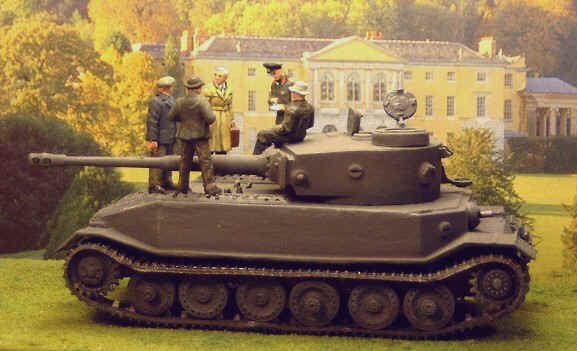
 This design philosophy of big, vertical armor plates stayed relatively constant throughout the Second World War, but that didn’t stop people from innovating on defensive design. Rather surprisingly, it was the Germans, not the Soviets, who first began their efforts to revolutionize the design of the heavy tank, even more surprisingly, it was the Porsche company, which was competing with others in Germany for the contract for what would later become the legendary Panzerkampfwagon VI “Tiger” Heavy Tank. This tank, the later known as the Tiger I(P) by historians, attempted to take the best parts of Soviet tank design – mainly the sloped armor, and mounting the turret forward on the chassis instead of in the middle – and apply them to a German heavy tank. And although many such design philosophies were adopted following the Second World War, Porsche’s tank was ahead of its time, not to mention riddled with mechanical problems. Even after numerous test runs, the tank was still prone to being stuck in the mud, suffering engine failure, and then spontaneously combusting, usually in that order. In a last act of desperation, the few remaining Tiger I(P)s were fitted for combat for the Battle of Berlin, but these were all destroyed In the fighting.

An artist's rendition of a Tiger I(P). Very few actual photos of the tank exist


Wednesday, December 3, 2014

What makes a Heavy Tank a Heavy Tank

So before anything else, it’s important to have some sort of standard definition to refer to whenever we use the term “heavy tank”. With the lack of very many modern heavy tanks (most modern tanks are Battle Tanks, we’ll get to that later), we’ll have to develop our general case based on observations of World War II designs, where heavy tanks saw the most use. So, what does this give us?


Well, going by the design principals of the US, Germany, and the USSR, most heavy tanks had the following in common: First and foremost, heavy tanks had much thicker armor than their lighter counterparts. In WWII this could be as little as 50 millimeters thicker armor to armor that was 75 than 100 millimeters thicker than that of lighter tanks. 

German heavy tanks like this Tiger II had nearly seven inches of armor plating at points

This contributes heavily to the second major commonality – the role of these vehicles on the battlefield. While light and medium tanks were often used to fulfil tactical objectives (hunting enemy tanks, raiding supply convoys, routing small infantry units, and the like), strategic objectives were fulfilled by massing heavy tanks at a point, and then telling them to stay put or advance depending on their objective. Their armor was often thick enough that they could take multitudes of shots, even from other tanks, before even suffering drops in performance. This meant that a squad of heavy tanks was more than capable of holding a position more than long enough for reinforcements to show up, or could easily be used to spearhead and attack on an enemy and almost immediately split their ranks.

The third major commonality was in the armament – heavy tanks always had the biggest and best cannons available at the time. This went doubly true for the USSR who routinely mounted 75 millimeter, 105 millimeter, 122 millimeter, and 152 millimeter cannons on their tanks, especially their heavier tanks - the KV-2 in the background is an excellent example, sporting a 152mm howitzer for a main cannon. 

The fourth major commonality was their painfully low speed. With all their arms and armament, that didn’t leave much room for an engine, so heavy tanks tended to be considerably slower than their counterparts. In summation, our definition of a heavy tanks is lots of armor, big guns, strategic application, and low speeds. So now that we know what a heavy tank is, we can define what it isn’t. 

Statement of Intent

This is a blog about heavy tanks. That sentence alone has probably already given you about a hundred questions. For example: Why write a blog about heavy tanks? What demand could possibly exist for such a thing? While I could give a relatively standard answer, such as “Because I want to”, or “Because I have to do it for school”, there are much better reasons for doing this. Most importantly – heavy tanks are fun. There is nothing boring about a large steel box with a giant cannon sticking out of it, striding across a battlefield at 20 kilometers per hour, impervious to anything it sees before it. And it’s fun to blog about fun things, so why not? But there’s another reason as well – many people tend to assume a general definition of what a heavy tank is based on what they’ve heard in popular culture, from movies or comics or video games. And it’s those people to whom the information here is primarily addressed – people who either consume media and have an incorrect definition of what a heavy tank is, and the people who produce this media using these incorrect definitions in the first place. This blog is all about what a heavy tank really is, and the engineering principals behind them.