The most important part of any tank is the armored shell
that protects components and crew alike. For Heavy Tanks, this protection is
even more important due to the nature of operations heavy tanks are used on,
which will often leave them exposed to counterfire from enemy tanks and
antitank weapons for extended periods of time. What’s interesting about heavy
tanks with regards to armor is that although the major tank builders of WWII
differed greatly when it came to their design philosophies regarding armament
and mobility, armor design stayed relatively constant, with three main criterion:
Heavy Tank armor had to be thick, thick enough to stop a shell on its own if
needed; it had to be simple, so that it could be easily mass-produced on a
large scale; and it had to be easily serviceable, so that armor plating could
be easily repaired in the field. In order to accomplish this, most heavy tanks
of WWII were designed with very thick armor with almost no sloping. While it
meant that the armor plating would take the full force behind a shot with very
little chance to simply deflect an incoming shell, it did mean that the armor
was so thick that said shells might simply get stuck in the armor and never
fully penetrate, or if they did, not have enough remaining velocity to cause
major damage to internal crew and components. Armor being simplified for
repairs meant that it was surprisingly easy to refit a heavy tank after a large
battle, greatly increasing their operational life. It also allowed for armor
kits to be more easily installed, boosting the damage tanking ability of a
heavy tank even further. Tanks like the Soviet KV-1 for example had their
existing tank shell to house the crew, and then armor made form steel sheets
that was made to be riveted on in the field for maintenance purposes.

A Soviet KV-1E. Notice the visible rivets on the armor plating
This
design philosophy of big, vertical armor plates stayed relatively constant
throughout the Second World War, but that didn’t stop people from innovating on
defensive design. Rather surprisingly, it was the Germans, not the Soviets, who
first began their efforts to revolutionize the design of the heavy tank, even
more surprisingly, it was the Porsche company, which was competing with others
in Germany for the contract for what would later become the legendary Panzerkampfwagon
VI “Tiger” Heavy Tank. This tank, the later known as the Tiger I(P) by historians,
attempted to take the best parts of Soviet tank design – mainly the sloped
armor, and mounting the turret forward on the chassis instead of in the middle –
and apply them to a German heavy tank. And although many such design
philosophies were adopted following the Second World War, Porsche’s tank was
ahead of its time, not to mention riddled with mechanical problems. Even after
numerous test runs, the tank was still prone to being stuck in the mud,
suffering engine failure, and then spontaneously combusting, usually in that
order. In a last act of desperation, the few remaining Tiger I(P)s were fitted
for combat for the Battle of Berlin, but these were all destroyed In the
fighting.
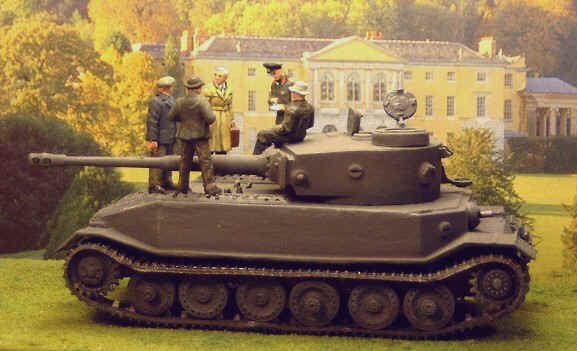
An artist's rendition of a Tiger I(P). Very few actual photos of the tank exist

No comments:
Post a Comment